
Press Brake Tonnage Chart & Calculator
Estimate the bending force required for your press brake operation. Select your material, thickness, and die opening to get a quick tonnage estimate — or scan the full reference chart below.
Tonnage Calculator
Required Tonnage
3.8tons
Tonnage Per Foot
3.8tons/ft
Die Opening
1/2"V-die
A 12" bend in 16 ga (0.06") Mild Steel using a 1/2" V-die opening requires approximately 3.8 tons of force. Based on standard air bending.
Tonnage Chart — Mild Steel
Tons per lineal foot for air bending. Click any cell to use it in the calculator.
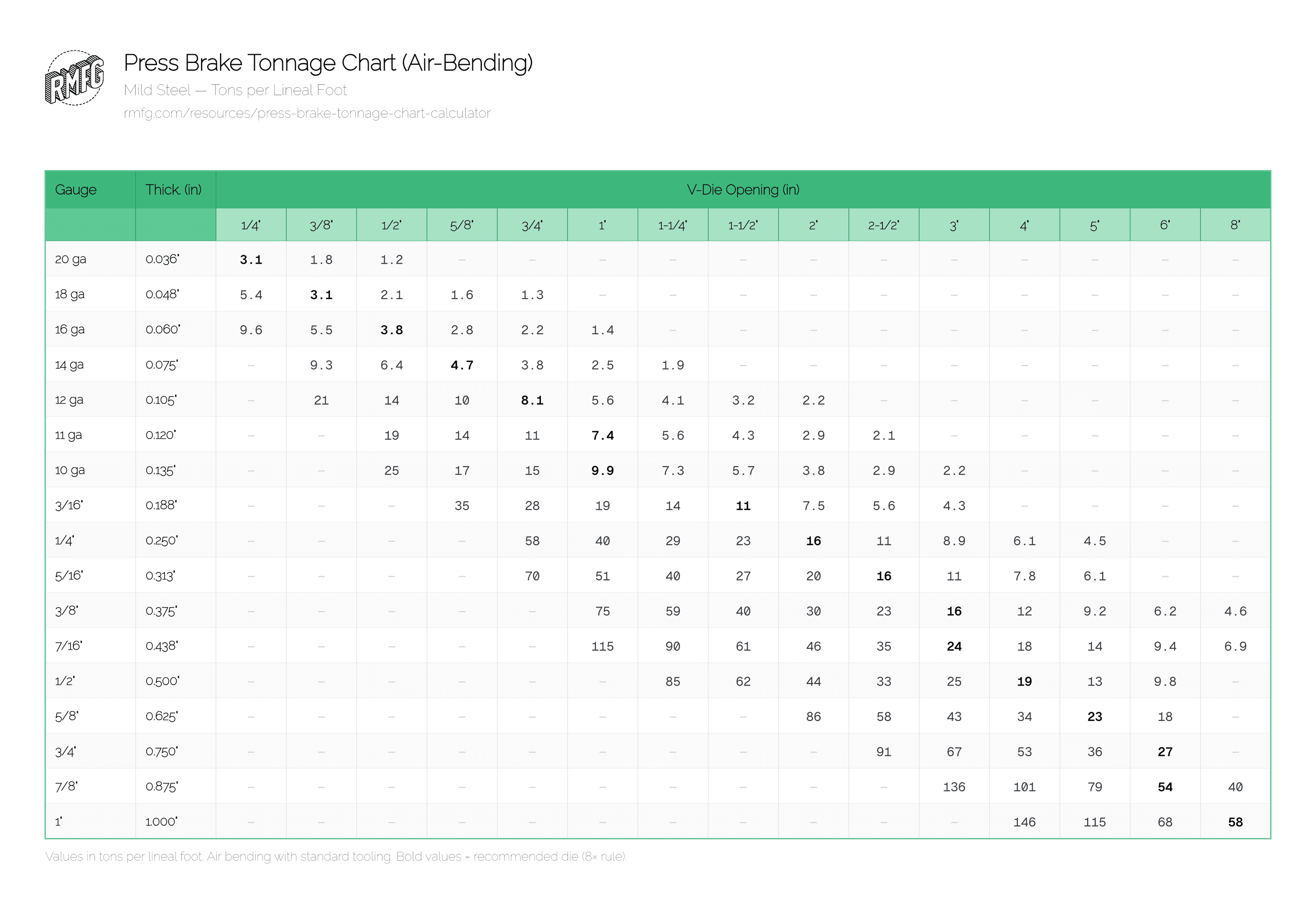
| Gauge | Thickness (in) | V-Die Opening (in) | ||||||||||||||
|---|---|---|---|---|---|---|---|---|---|---|---|---|---|---|---|---|
| 1/4" | 3/8" | 1/2" | 5/8" | 3/4" | 1" | 1-1/4" | 1-1/2" | 2" | 2-1/2" | 3" | 4" | 5" | 6" | 8" | ||
| 20 ga | 0.036" | 3.1* | 1.8 | 1.2 | — | — | — | — | — | — | — | — | — | — | — | — |
| 18 ga | 0.048" | 5.4 | 3.1* | 2.1 | 1.6 | 1.3 | — | — | — | — | — | — | — | — | — | — |
| 16 ga | 0.060" | 9.6 | 5.5 | 3.8 | 2.8 | 2.2 | 1.4 | — | — | — | — | — | — | — | — | — |
| 14 ga | 0.075" | — | 9.3 | 6.4 | 4.7* | 3.8 | 2.5 | 1.9 | — | — | — | — | — | — | — | — |
| 12 ga | 0.105" | — | 21 | 14 | 10 | 8.1* | 5.6 | 4.1 | 3.2 | 2.2 | — | — | — | — | — | — |
| 11 ga | 0.120" | — | — | 19 | 14 | 11 | 7.4* | 5.6 | 4.3 | 2.9 | 2.1 | — | — | — | — | — |
| 10 ga | 0.135" | — | — | 25 | 17 | 15 | 9.9* | 7.3 | 5.7 | 3.8 | 2.9 | 2.2 | — | — | — | — |
| 3/16" | 0.188" | — | — | — | 35 | 28 | 19 | 14 | 11* | 7.5 | 5.6 | 4.3 | — | — | — | — |
| 1/4" | 0.250" | — | — | — | — | 58 | 40 | 29 | 23 | 16* | 11 | 8.9 | 6.1 | 4.5 | — | — |
| 5/16" | 0.313" | — | — | — | — | 70 | 51 | 40 | 27 | 20 | 16* | 11 | 7.8 | 6.1 | — | — |
| 3/8" | 0.375" | — | — | — | — | — | 75 | 59 | 40 | 30 | 23 | 16* | 12 | 9.2 | 6.2 | 4.6 |
| 7/16" | 0.438" | — | — | — | — | — | 115 | 90 | 61 | 46 | 35 | 24* | 18 | 14 | 9.4 | 6.9 |
| 1/2" | 0.500" | — | — | — | — | — | — | 85 | 62 | 44 | 33 | 25 | 19* | 13 | 9.8 | — |
| 5/8" | 0.625" | — | — | — | — | — | — | — | — | 86 | 58 | 43 | 34 | 23* | 18 | — |
| 3/4" | 0.750" | — | — | — | — | — | — | — | — | — | 91 | 67 | 53 | 36 | 27* | — |
| 7/8" | 0.875" | — | — | — | — | — | — | — | — | — | — | 136 | 101 | 79 | 54* | 40 |
| 1" | 1.000" | — | — | — | — | — | — | — | — | — | — | — | 146 | 115 | 68 | 58* |
* Recommended die opening (approximately 8× material thickness). Click any cell to calculate total tonnage for a specific bend.
Downloadable Mild Steel Tonnage Charts
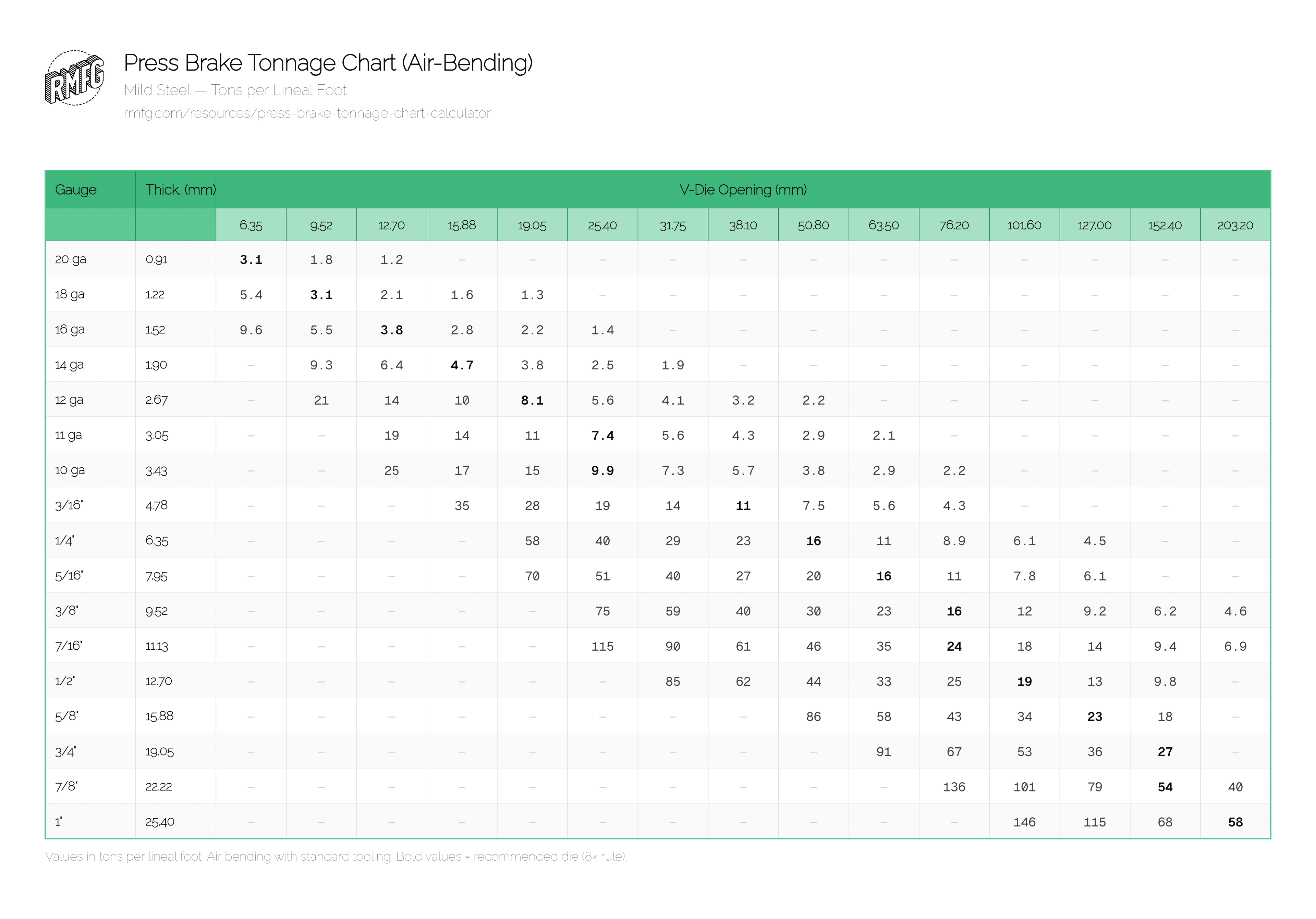
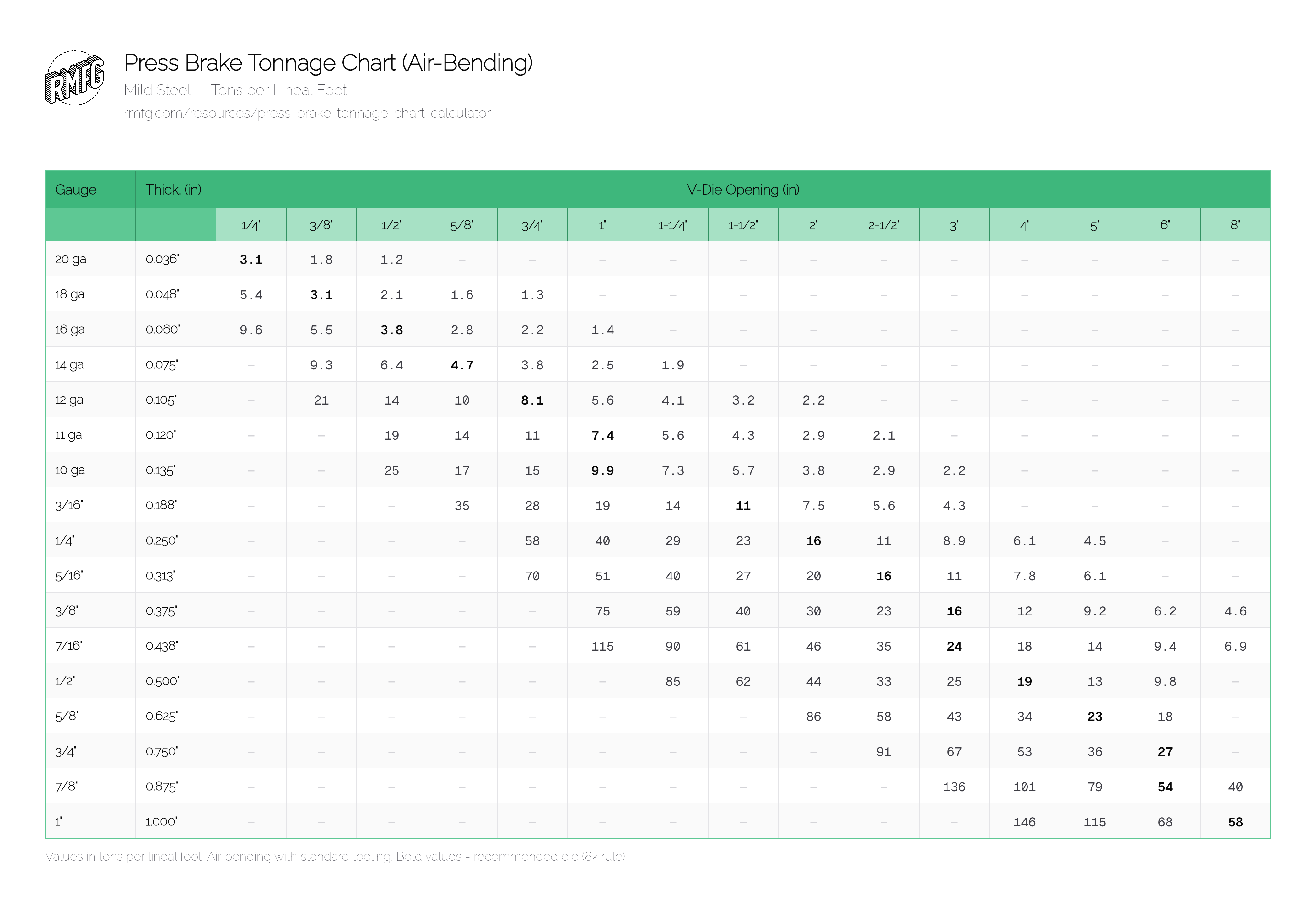
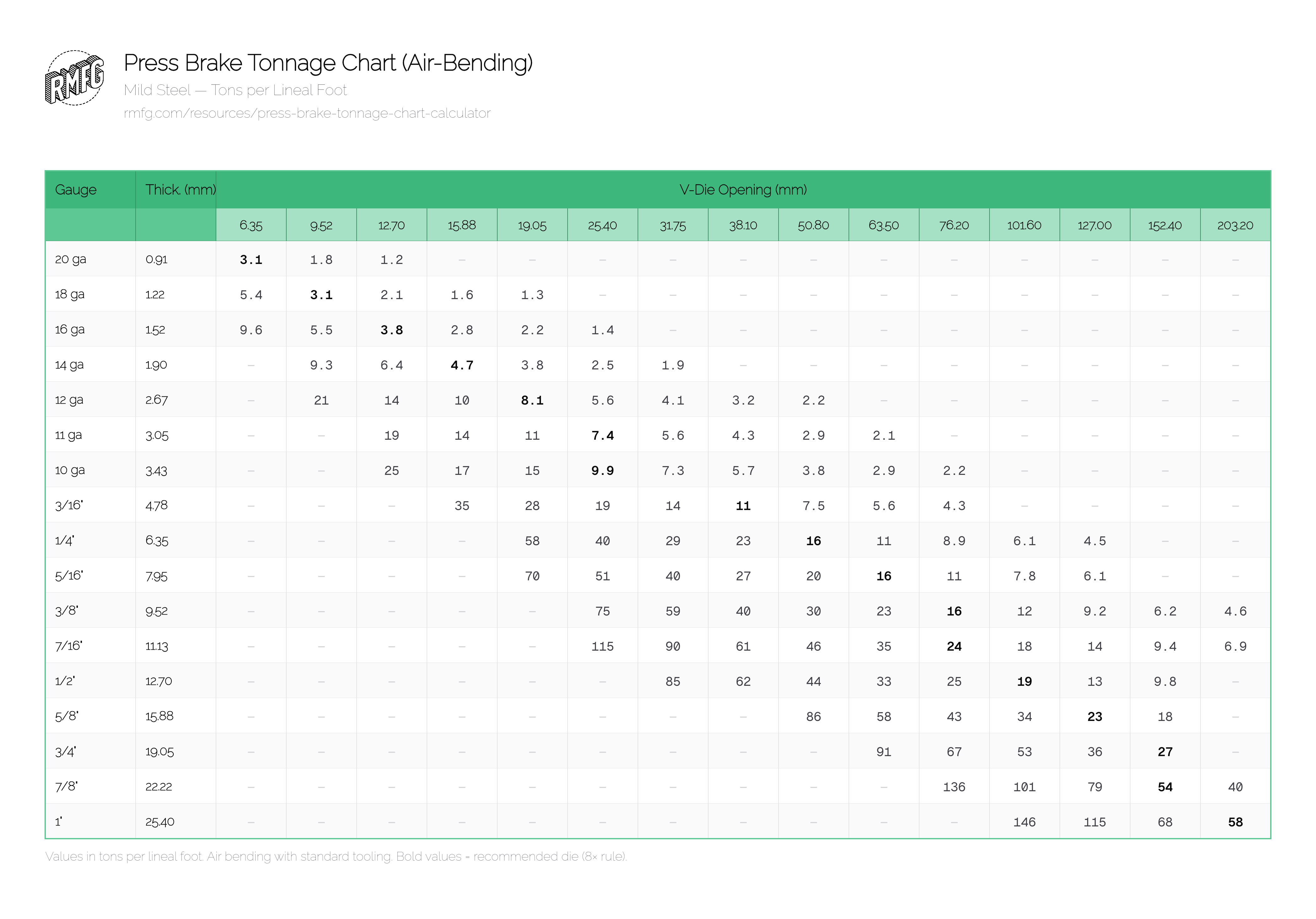
Save or share these charts. Right-click to copy, or use the download buttons.
What Is Press Brake Tonnage?
Press brake tonnage is the amount of force a press brake must apply to bend sheet metal to a desired angle. It's measured in tons and depends on material type, material thickness, bend length, and the V-die opening used. Getting this number right matters — too little tonnage and the bend won't form correctly, too much and you risk damaging tooling or the machine.
Why Material Choice Matters
Different metals have different tensile strengths, which directly affects bending force. Aluminum is softer and requires roughly half the tonnage of mild steel. Stainless steel is harder and requires about 50% more. This chart uses standard multipliers — 0.5× for aluminum, 1.0× for mild steel, and 1.5× for stainless — applied to base air-bending values.
Why Tonnage Charts Vary Between Sources
Different tonnage charts can show different values because they assume different die openings, bending methods (air bending vs. bottom bending), or material grades. This chart is based on standard air bending using the 8× die opening rule and 60,000 PSI mild steel baseline — the most common setup in production sheet metal shops. The values here are conservative and validated against real RMFG press brake runs.
The 8× Die Opening Rule
The standard rule of thumb is to use a V-die opening of approximately 8 times the material thickness. For example, 0.060" (16 gauge) material uses a 0.5" die opening. This ratio provides optimal bend quality while keeping tonnage requirements reasonable. Using a smaller die opening increases the required tonnage significantly, while a larger opening reduces it — but at the cost of a larger bend radius and potentially less precise angles.
Need Custom Bent Parts?
RMFG specializes in custom sheet metal fabrication with precision cutting, bending, and finishing. Upload your design and get an instant quote.
Get an instant quoteFrom our customers.
Read reviews on Google“Their parts almost always ship ahead of schedule, and their customer service is excellent.”

“RMFG always does a great job with our parts. Quick lead times and lots of options, couldn't recommend them enough!”

“Always fast, perfect, inexpensive parts. Never had a problem with RMFG and love doing business with them.”

“RMFG is my go-to whenever I'm prototyping anything with sheet metal.”

“The price was very reasonable, the quality was excellent, and the lead time was good.”
“Have ordered from them half a dozen times and the experience is always great. Transparent pricing, incredibly responsive, and always on-time delivery”
“When I need sheet metal parts FAST, the go to default for me now is RMFG!”

“Kenneth and the whole team are stellar at what they do. Amazing quality parts”
“RMFG does a great job every time”
“Great interface and experience, easily my default option now.”

“It's unbelievable to order & get the parts in hand on the same week!”

“RMFG has insane customer service every-time. If a part is critical, use them.”